
What do the models really cost?
If you're wondering what the models cost, don't look at the provider's listed price
This is a translation of a Norwegian article I initially published on LinkedIn, July 7 2026.
If you're going to compare different models on cost, the list prices aren't where you should look.
But let's start with a price list anyway, clipped from claude.com/pricing on June 6, 2026:
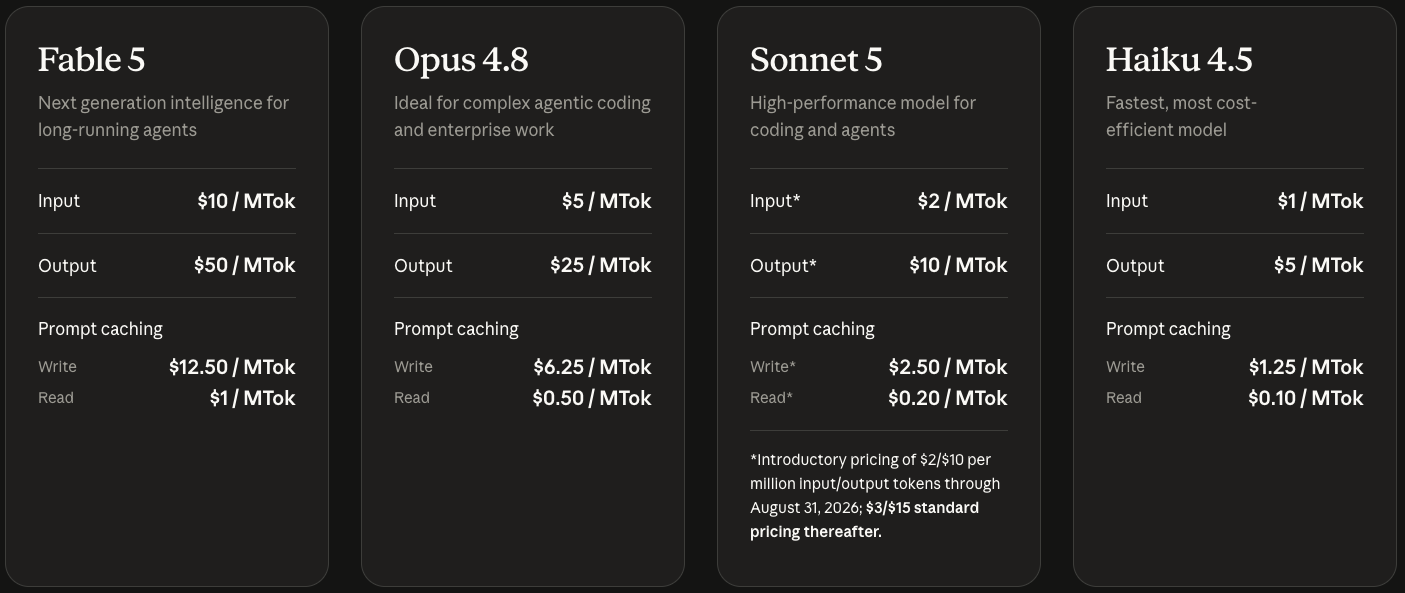
What do the price lists tell you?
Only the price. Not what the models cost. That's not unusual, of course, but I'll illustrate why the price list is both necessary and misleading, because the price tells you much less about the cost than we're used to.
(We'll set subscriptions aside, as they're primarily relevant to individuals, not businesses. They're also hard to use in calculations, since the number of included tokens isn't fixed. Or even published...)
How model usage is priced
AI companies price models per 1 million input / output tokens (1 token ≈ 4 characters).
"OK Marius, surely that means a model priced at $5 / $25 (Opus) is 150% more expensive to use than one priced at $2 / $10 (Sonnet), right?"
That's a natural assumption, but unfortunately it isn't so. Nor is calculating the actual cost simple or predictable, but by digging a little we can find what we need to compare models more effectively.
What determines the price you pay isn't primarily each model's list price, but how efficient the model is.
Let's do some math
What we're really interested in, of course, is cost, not price.
Real cost = price per token times tokens per task
or
            list price
Real cost = ────────── × tokens per task
            1,000,000
because it looks cooler, and I come off a little smarter.
This seems pretty obvious, until we realize that models vary enormously in how many tokens they use for the same task. Even between two successive versions of the same model!
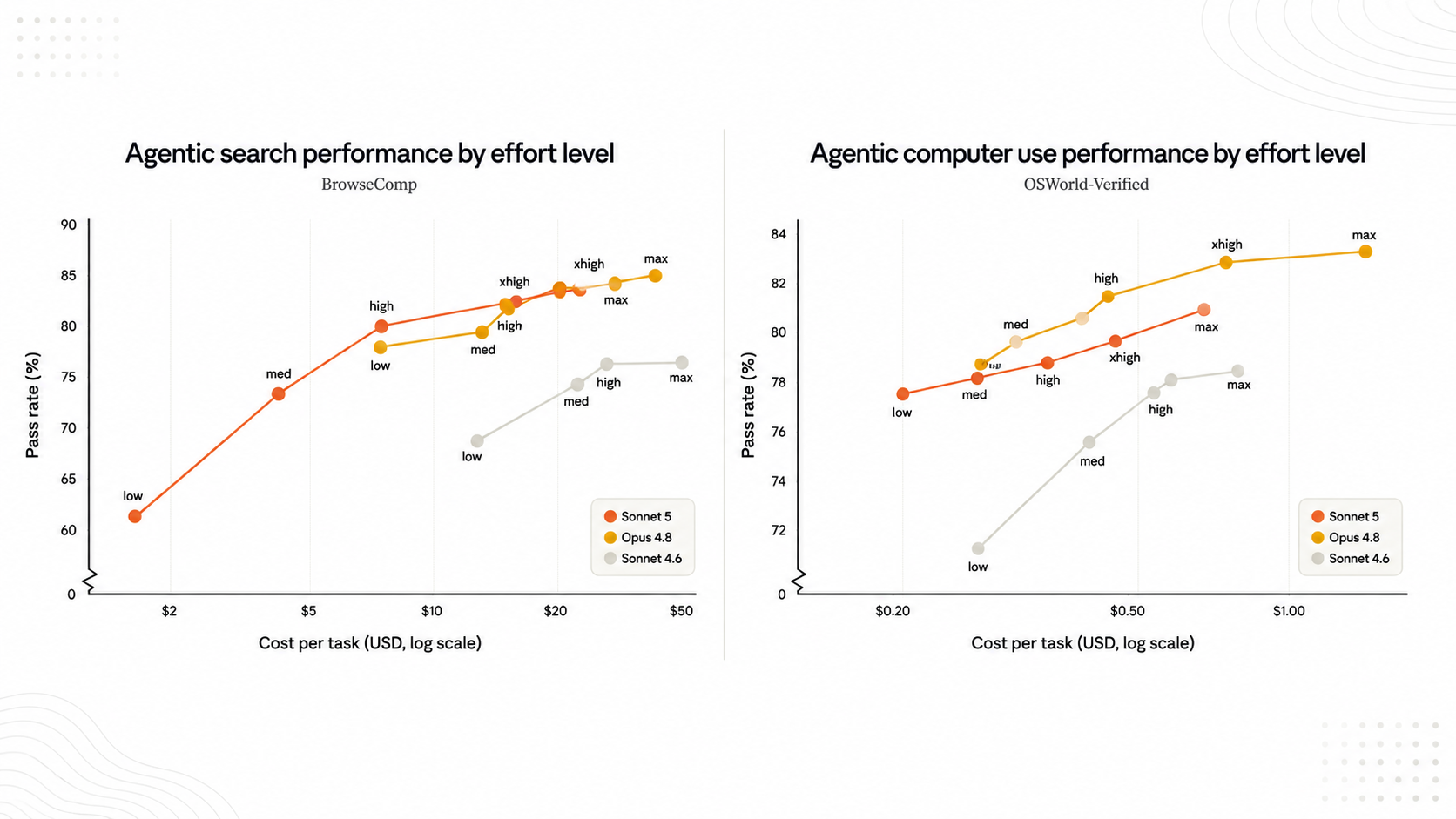
Anthropic boasts that Sonnet 5 is much more efficient than its predecessor, and offers a couple of graphs that seem to support this:
But what is efficiency?
We can measure efficiency on two axes:
Tokens per task, meaning the total number of tokens a model spends to perform a task.
Time per task, meaning how long the model took to perform the task.
The first is most visible to whoever pays the bill for using Anthropic's models, so it's usually the one that gets the most attention. Let's start there.
Efficiency measure: tokens per task
Anthropic's nice graphs have "Cost per task" on the X-axis, but we don't know how they arrived at it. (Yes, they do link to BrowseComp and OSWorld, but those pages are written for a very different audience than you and me, and most of us need two Ibuprofen before trying to read them.)
I'm not saying they're lying, but BrowseComp and OSWorld-Verified don't necessarily translate to the average tasks businesses use Claude for.
Artificial Analysis (AA from here on) is an independent company that runs models through 9 different benchmarks to compare them across a range of areas, and combines these measurements into a few shared graphs. They've recently included Sonnet 5 in some of their overviews, for example this one (note: AA runs tests like these regularly, and the graphs on their site may differ somewhat from the screenshots I'm using here, all taken around midday on June 6, 2026):
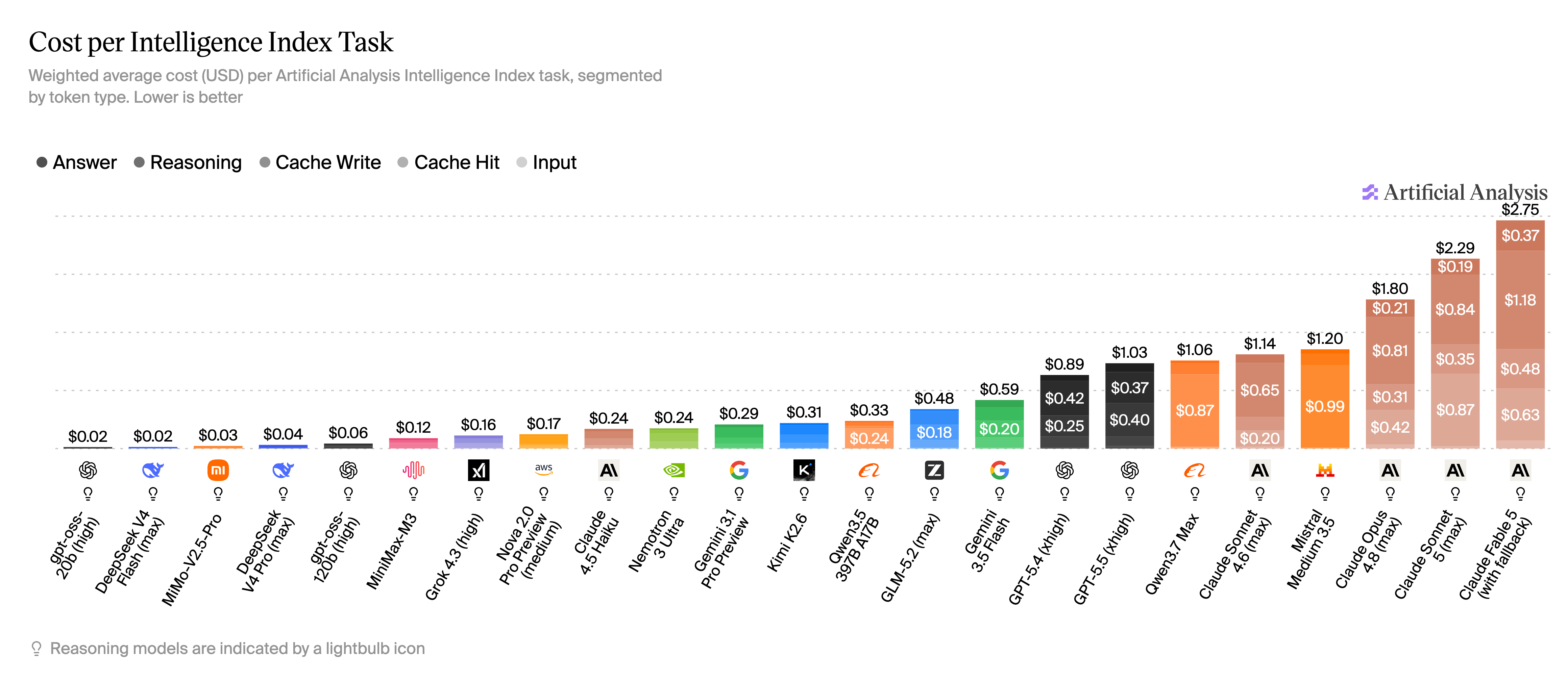
Here they've combined what each model cost per task across the 9 benchmarks (weighted).
The first thing we notice is that the three most expensive models are Opus 4.8, Sonnet 5 and Fable 5. Wait... Sonnet 5 is 27% more expensive than Opus 4.8!? But according to Anthropic, Sonnet 5 is close to Opus 4.8 in performance, at a lower price. And that's where the semantics matter: the price may be lower, but according to AA the cost is higher. Lower price, yet more expensive to use.
If we look at where the models fall on a graph showing the relationship between intelligence and cost, AA agrees with half of Anthropic's claim: Sonnet 5 isn't far below Opus 4.8 in intelligence, but comes at a higher cost:
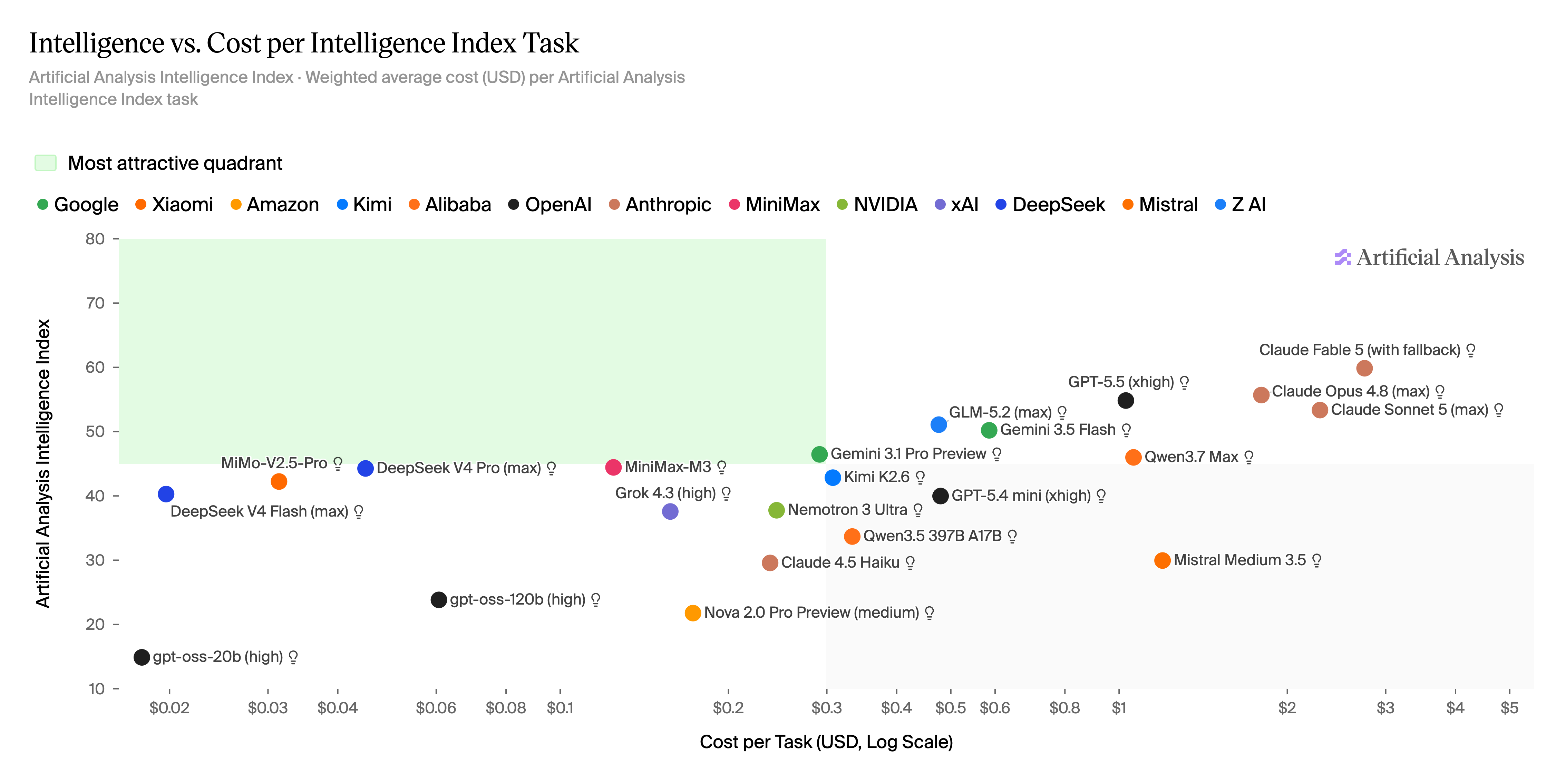
(note: this screenshot is from July 2, since Fable isn't shown on the live graph at the time of writing)
AA also has a graph showing how much it cost in total to run all the evaluations (pretty expensive, I'd say, which makes it clear these measurements are extensive).
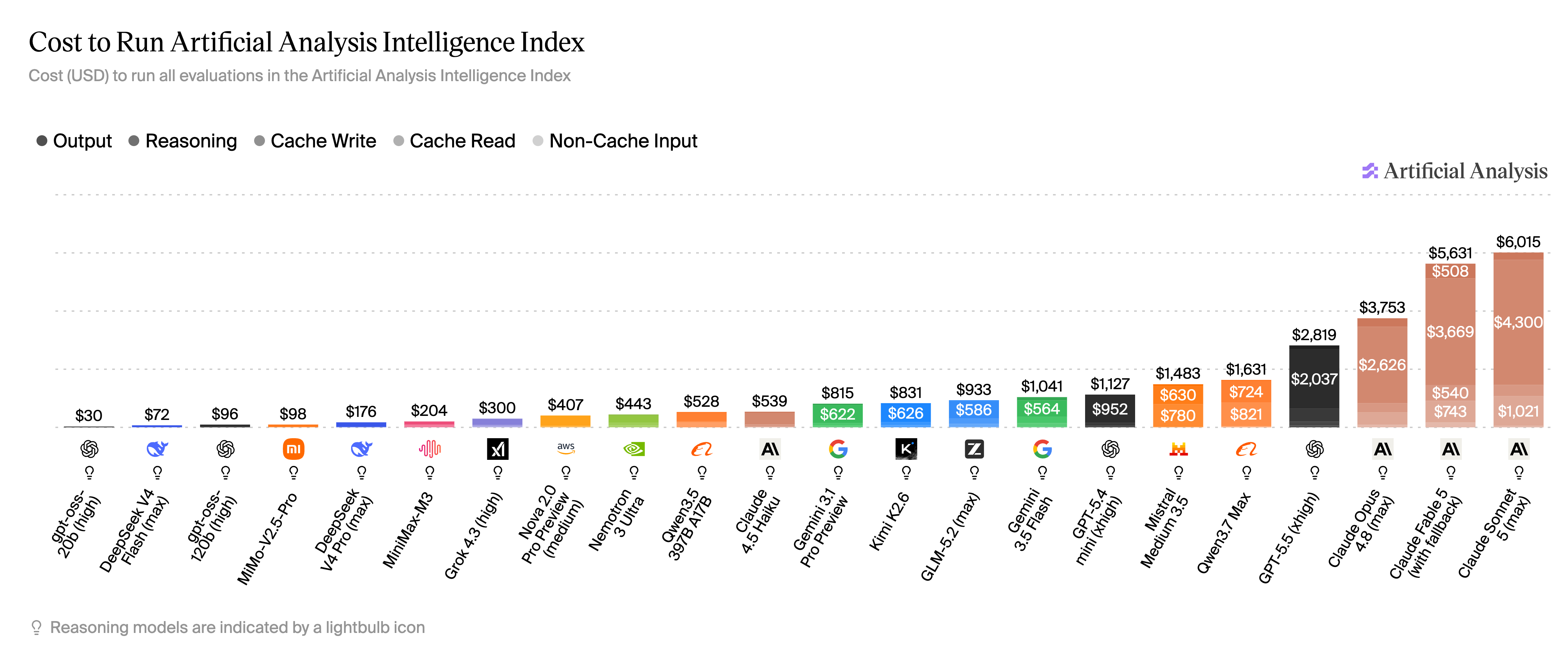
And here's another surprise: Sonnet 5 is even more expensive than Fable! A model with a price of $10 / $50 compared with Sonnet 5 at $2 / $10, meaning a five times higher price, yet a lower cost to complete all the evaluations 😳
That makes it problematic to claim Sonnet 5 is an efficient model based on what it costs to use.
Fine, but efficiency can also be measured by the time it takes to complete tasks, right? Because if it's more expensive to use but much faster, that could be a good argument for its efficiency.
Good thinking! I thought the same thing, so let's look at that too, because AA has measured it:
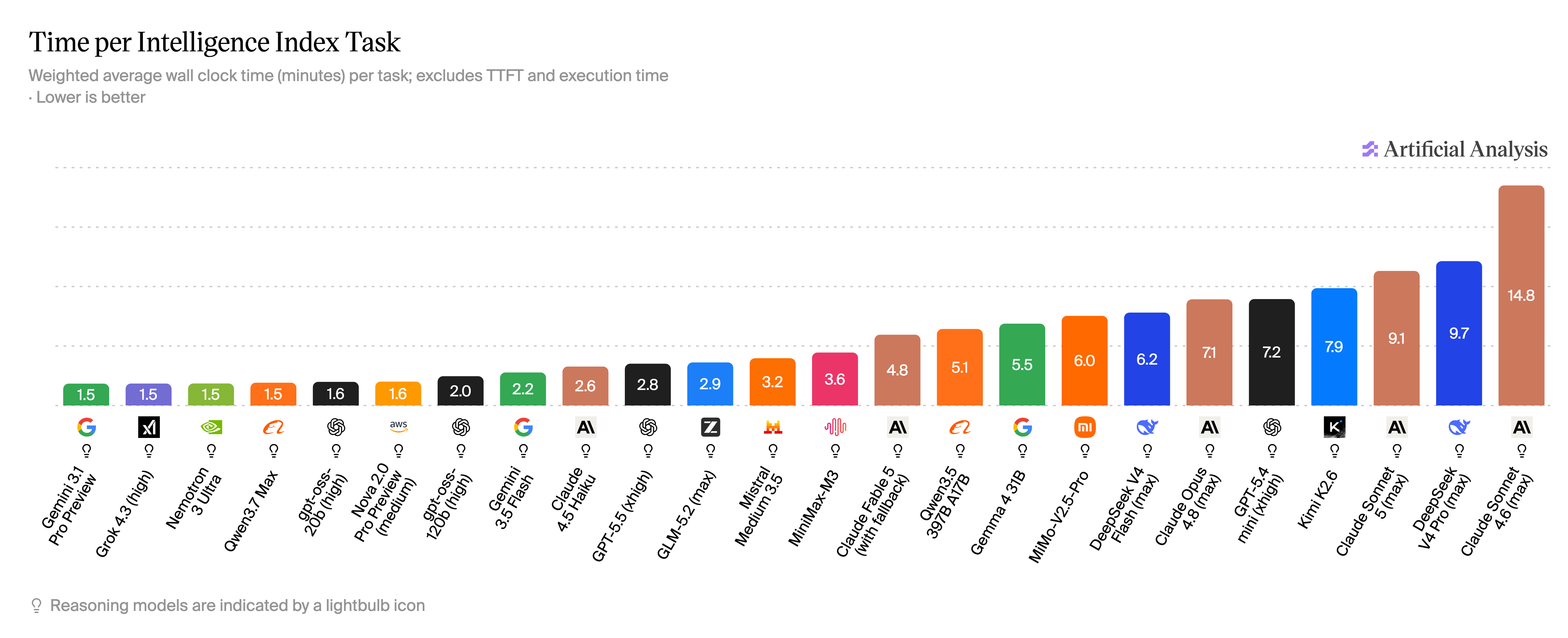
Sonnet 5 isn't just costly in money spent, it's also the third slowest of all the models, beaten only by DeepSeek V4 Pro and its own predecessor (interestingly, this lines up pretty well with my own unofficial benchmark from a few weeks ago, except that Kimi K2.6 has become substantially faster than the version I used back then).
Why only talk about Anthropic?
Of course, it's not all about Anthropic, even if the news and social media can make it seem that way. And just as interesting as comparing Sonnet 5's actual cost with its price is seeing where OpenAI's GPT models sit on these graphs, compared to Claude models.
Scroll back up and look for the black bars, and you'll see that OpenAI's top model GPT 5.5 (until the US authorities let us access 5.6) costs just slightly more than one third of Sonnet 5 per task, even though its price is higher than Opus 4.8's! AA has also measured it as more than 3 times faster.
And GPT 5.4, which is often compared to Sonnet 4.6, costs one fifth of Sonnet 5.
Ouch.
So what does all this actually mean for you and me?
The most important takeaway:
Don't compare models based on the labs' listed prices
AA have weighted their numbers based on their judgment of which types of tasks matter most for a model to be good at. Those of us who use the models need to do exactly that too, and for your particular business, the weighting could be completely different than mine, and so could the results.
And above all, we need to test each model against a selection of the tasks for which we use models most. Every company should invest in building some benchmarks of their own to test models as they're released. If Sonnet 4.6 was the model you used for "mid-tier" tasks, that doesn't mean you should automatically "upgrade" to Sonnet 5.
With Sonnet 5, Anthropic has delivered a model that behaves very differently from its predecessor, and is much closer to Opus in the way it structures work into tasks and distributes them to sub-agents. Unfortunately, it takes both more time and more tokens to do this than Opus. For a slightly worse result, according to Artificial Analysis. So, right now, replacing Sonnet 4.6 with Opus 4.8 as your daily driver makes more sense than switching to Sonnet 5.
Overviews like these are an important indication, but they're not a definitive answer. We need to make our own judgments based on our tasks.
And what we should absolutely not base our choices on is the companies' own marketing.